Webhook 格式
如果你通过 webhook 订阅,收到的内容格式如下:
添加或更新事件时:
{"meta": {"unsubscribe": "","documentation": ""},"page": {"id": "","status_indicator": "","status_description": "","url": ""},"incident": {"backfilled": false,"created_at": "","impact": "","name": "","resolved_at": "","status": "","updated_at": "","id": "","url": "","incident_updates": [{"id": "","incident_id": "","body": "","status": "","created_at": "","updated_at": ""}]}}
添加或更新维护时:
{"meta": {"unsubscribe": "","documentation": ""},"page": {"id": "","status_indicator": "","status_description": "","url": ""},"maintenance": {"backfilled": false,"created_at": "","impact": "","name": "","resolved_at": "","status": "","updated_at": "","id": "","url": "","duration": "","maintenance_updates": [{"id": "","maintenance_id": "","body": "","status": "","created_at": "","updated_at": ""}]}}
组件更新时:
{"meta": {"unsubscribe": "https://<status-page-domain>/unsubscribe?id=${subscriber.id}&token=${subscriber.unsubscribeToken}","documentation": ""},"page": {"id": "","status_indicator": "","status_description": "","url": ""},"component_update": {"created_at": "","new_status": "","component_id": ""},"component": {"created_at": "","id": "","name": "","status": ""}}
可能的状态页状态:
UPHASISSUESUNDERMAINTENANCE
可能的组件状态:
OPERATIONALUNDERMAINTENANCEDEGRADEDPERFORMANCEPARTIALOUTAGEMAJOROUTAGE
可能的事件状态:
INVESTIGATINGIDENTIFIEDMONITORINGRESOLVED
可能的维护状态:
NOTSTARTEDYETINPROGRESSCOMPLETED
Webhook 负载校验
强烈建议在 webhook 端点中校验负载。
我们用一个密钥对 webhook 负载签名,并把签名放在名为 x-instatus-webhook-signature 的请求头中。这个签名让你可以验证该 webhook 确实来自 Instatus。
校验 Webhook 的步骤
- 保存你在订阅 webhook 时生成的 Webhook Secret(在为某个页面订阅 webhook 时可以看到,也可以在那里自定义它)。
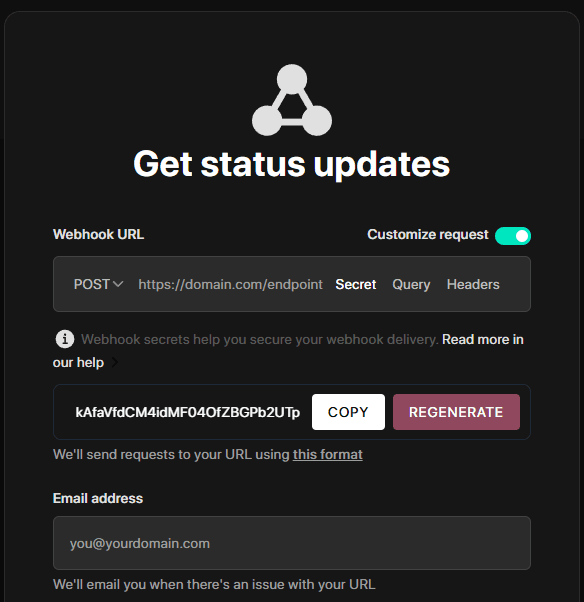
-
在你的服务器上创建一个接收该 webhook 的新端点。
-
把收到的签名与服务器生成的签名进行比较来校验。
-
如果签名一致,就处理这个 webhook。
代码示例
import crypto from 'crypto'import express from 'express'const app = express()app.use(express.json())const WEBHOOK_SECRET = 'your-webhook-secret'function isVerifiedPayload(payload, signature, secret) {const hmac = crypto.createHmac('sha256', secret)const digest = hmac.update(JSON.stringify(payload)).digest('hex')return crypto.timingSafeEqual(Buffer.from(digest), Buffer.from(signature))}app.post('/endpoint/to/webhook', (req, res) => {const payload = req.bodyconst signature = req.header('x-instatus-webhook-signature')if (!signature) {return res.status(400).send('Signature missing')}if (!isVerifiedPayload(payload, signature, WEBHOOK_SECRET)) {return res.status(401).send('Invalid signature')}// Process the valid webhookres.status(200).send('Webhook received')})app.listen(3000, () => console.log('Server running on port 3000'))
为什么校验很重要
- 确保真实性:保证该 webhook 确实来自我们的平台。
- 防止篡改:能发现负载被改动过。
- 提升安全性:防范重放攻击和未授权访问。